The Frame Held Too Long
A display can refresh at 120 Hz and still produce motion blur your eye cannot ignore. The physics behind that paradox starts with how long each pixel stays lit.
What the Retina Is Actually Tracking
Your eye does not sample a scene the way a camera shutter does. During smooth pursuit — the reflex that kicks in when you track a moving object — the eye rotates continuously, following the object across the visual field. That rotation is involuntary and essentially perfect at low to moderate velocities. The brain does not perceive the motion as a series of snapshots; it expects a continuously moving image.
A CRT obliged that expectation almost by accident. Each phosphor spot was excited by an electron beam for a fraction of a millisecond, then began decaying immediately. The decay time constant was short enough — typically a few hundred microseconds at P22 phosphor — that by the time the beam returned on the next field, the previous emission had largely collapsed. The image existed, briefly and brightly, and then it was gone. Your tracking eye saw something that approximated a moving smear of light, and the smear was narrow, because the luminous interval was short.
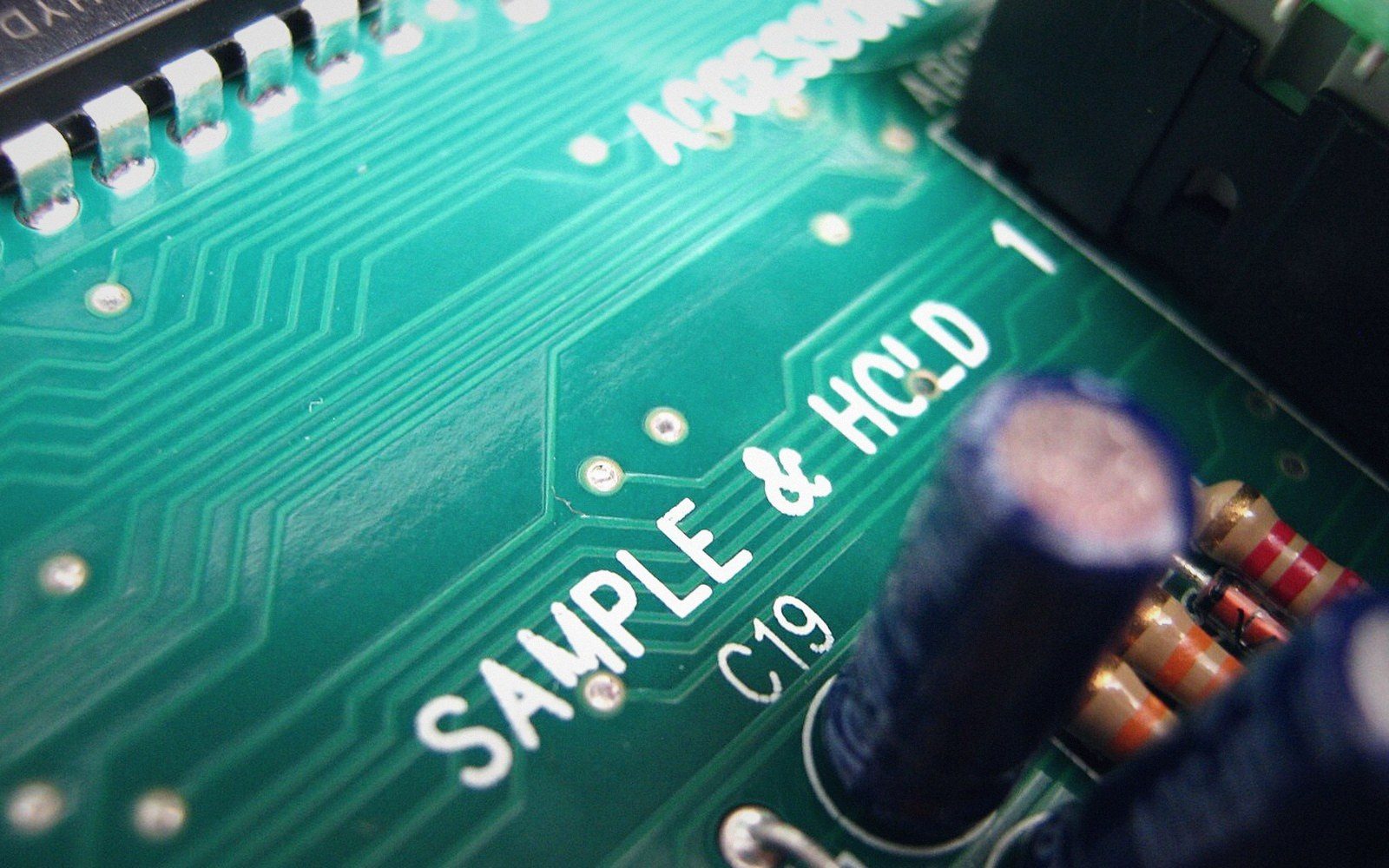
An LCD, OLED, or any sample-and-hold display does the opposite. It latches a pixel value and holds it at constant luminance for the entire frame period. At 60 Hz that is approximately 16.7 milliseconds. At 120 Hz it is 8.3 ms. At 240 Hz it is 4.2 ms. The pixel does not decay; it waits.
Why Holding Is the Problem
Picture a white dot moving across a black background at 960 pixels per second — a perfectly ordinary velocity for an object crossing a 4K screen in about four seconds. At 60 Hz, the display updates 60 times per second. In the 16.7 ms between updates, the white dot moves 16 pixels. But the display does not move the dot — it holds it stationary at its frame-N position for the full 16.7 ms, then snaps it to its frame-(N+1) position.
Your eye, meanwhile, is tracking the object continuously. It rotates to follow the expected trajectory. The retina therefore sweeps across the held pixel over those 16.7 ms, and the integration of a stationary pixel across a moving retina produces exactly the same physiological outcome as a physically blurred image: the photoreceptors accumulate light from that fixed pixel over a range of angular positions. The perceived blur width in pixels equals the object velocity in pixels-per-second multiplied by the hold duration in seconds. At 960 px/s and 16.7 ms, that is 16 pixels of blur. It is not a content problem, not a compression artefact, not a panel response-time problem — it is a display architecture problem.
The calculation does not lie: doubling the frame rate to 120 Hz halves the hold time to 8.3 ms, halving the blur to 8 pixels. That is a genuine, measurable improvement. Doubling again to 240 Hz gives 4 pixels. The relationship is linear, so you never eliminate the blur by frame rate alone — you asymptote toward it. At a hypothetically infinite frame rate the hold time, and therefore the blur, would shrink to zero, but only in the limit.
This is categorically different from what is usually called panel response time — the speed at which a liquid-crystal layer actually rotates between grey levels, which introduces its own trailing artefacts. Sample-and-hold blur exists even on an instantaneously perfect panel. It would afflict a display whose pixels switched in zero nanoseconds, if those pixels remained held at their new value for the rest of the frame period.
Escape Routes, and What They Cost
Engineers have two practical routes out of sample-and-hold blur: shorten the hold time, or interpolate additional frames to reduce the inter-frame displacement.
Shortening the hold time is the more principled approach. Black-frame insertion (BFI) does exactly that: after each image frame, the backlight or pixel is blanked for some fraction of the frame period, reducing effective hold time without changing the native panel refresh rate. If a 120 Hz display blanks the backlight for half of each frame period, the effective hold time drops from 8.3 ms to approximately 4.2 ms, matching the perceptual clarity of a 240 Hz display. The cost is luminance: half-duty-cycle blanking cuts peak brightness by half before any other factor, and the tradeoff between motion clarity and brightness is unavoidable. Strobing can also introduce perceptible flicker at lower frequencies, and its interaction with variable refresh rate is mechanically awkward — the tradeoffs that BFI forces deserve their own treatment.
Motion-compensated frame interpolation (MCFI) — the processing that generates intermediate frames from optical-flow estimation — reduces inter-frame object displacement and therefore reduces retinal sweep per hold period. A 24 fps source interpolated to 120 fps genuinely cuts sample-and-hold blur for steady camera movement. The objection is not that it fails on blur; the objection is that its motion-vector estimation introduces processing artefacts, adds latency, and imparts the over-smooth cadence that critics call the soap-opera effect — a perceptually distinct signature that many viewers find more offensive than the original blur. For gaming, the added latency is usually disqualifying.
A third path, used in some high-end LCD implementations, is scanning backlight illumination: the backlight sweeps a lit zone down the panel in synchrony with the scan-out, illuminating each row only briefly as the pixel data arrives and then switching it off. The effect approximates CRT phosphor behaviour without the electron gun, and it preserves some of the luminance that blanking discards — though at the cost of manufacturing complexity and the potential for visible horizontal scan lines under static inspection.
Reading the Spec Sheet
A panel rated at 120 Hz native and advertised as "motion enhanced" is probably using one of these techniques, and the spec sheet rarely says which. The number to interrogate is effective hold time, which manufacturers rarely publish. A 240 Hz native panel with no BFI beats a 120 Hz panel with 50 % BFI by exactly zero advantage in sample-and-hold blur; they are equivalent at 4.2 ms hold time and equivalent in luminance penalty (the 240 Hz panel accepts half as many interpolated frames' worth of content, but the hold physics are the same). What varies is artefact type: the 240 Hz path demands genuine high-frame-rate content or introduces interpolation; the 120 Hz BFI path demands brightness headroom.
The CRT is gone and its physics went with it. What replaced it — every flat panel technology in volume production — is a sample-and-hold architecture, and every such architecture trades motion fidelity against frame rate in the same linear way. Knowing that, a reader can look at any quoted refresh number, multiply the period by the duty cycle, and work out the actual hold time. That number predicts the blur width for a given object velocity. Everything else on the spec sheet is commentary.